前言
很高兴现在接手的项目让我接触到了Python Graphql,百度上对其介绍相对较少也不够全面,几乎没有完整的中文文档,所以这边也借此机会学习一下Graphql。
什么是Graphql呢?
Graphql是一个API查询语言,其数据由服务器上的一个Scheme提供,其查询返回的数据依赖请求的时候用户需要的精确数据。列如用户只需要一个name字段,服务器也只返回name的值。
参考
英文学习文档:https://graphene-python.org/
更多example关注:https://github.com/graphql-python/graphene/tree/master/examples
Hello Word 入门
先看下面一个例子,查询语句为{ hello(name:"gaojiayi") } 定义了要查询的入口,以及传入的参数。
from graphene import ObjectType, String, Schema

class Query(ObjectType):
    """定义一个字符串属性域hello 且有一个字符串参数为name,设置name的默认"""
    hello = String(name = String(default_value="gaojy",required=True))

    # resolve_hello定义了上面hello的实现,并返回查询结果
    # 一般resolve需要加上固定前缀resolve_
    @staticmethod
    def resolve_hello(root,info,name):
        return f"hello word -- {name}"

schema = Schema(query=Query)

if __name__ == '__main__':
    query_string = '''{ hello(name:"gaojiayi") }'''
    result = schema.execute(query_string)
    print(result.data['hello'])
Graphql中的Types
Scheme
下面定义了一个Scheme,其中MyRootQuery,MyRootMutation,MyRootSubscription都是继承了graphene .objectType,但是不同之处在于query定义了查询数据的入口,而mutation用来数据改变或者数据恢复,而subscription是用来实时呈现数据的变化给client。type是用来指定返回数据的精确类型,列如返回的数据是一个interface,但是有多个类型继承了该interface,这时候需要指定一个具体的实现来返回给client。
my_schema = Schema(
    query=MyRootQuery,
    mutation=MyRootMutation,
    subscription=MyRootSubscription,
   type=[SomeExtraObjectType,]
 )
另外查询字符串默认为驼峰命名,列如
from graphene import ObjectType, String, Schema

class Query(ObjectType):
    other_name = String(name='_other_Name')

    @staticmethod
    def resolve_other_name(root, info):
        return "test CamelCase"


schema = Schema(query=Query)

if __name__ == '__main__':
    # 查询数默认使用otherName,此处用了别名。
    result = schema.execute('''{_other_Name}''')
    print(result.data['_other_Name'])
如果关闭默认驼峰命名方式,则可以在定义scheme的时候加上auto_camelcase=False
my_schema = Schema(
    auto_camelcase=False
)
scalars
scalars type可以理解为用来定义Field,它可以传入以下几种可选参数,例如
other_name = String(name='_other_Name',required=True,description="",deprecation_reason="",defalut_value=Any)
常见的基本saclars type有如下几个:
graphene.String
graphene.Int
graphene.Float
graphene.Boolean
graphene.ID
graphene.types.datetime.Date
graphene.types.datetime.DateTime
graphene.types.datetime.Time
graphene.types.json.JSONString
View Code
saclars type的挂载在objectType,interface,Mutation中的field域中。
class Person(graphene.ObjectType):
    name = graphene.String()

# Is equivalent to:
class Person(graphene.ObjectType):
    name = graphene.Field(graphene.String)
View Code
Lists and Non-Null
Non-Null
import graphene

class Character(graphene.ObjectType):
    name = graphene.String(required=True)
#等价于 即返回的数据如果name=null,则会报错
class Character(graphene.ObjectType):
    name = graphene.String(required=True)
Lists
import graphene

class Character(graphene.ObjectType):
    # appears_in表示为一个非null元素的列表
    appears_in = graphene.List(graphene.NonNull(graphene.String))
ObjectType
objectType是在scheme中用来定义Fields之间联系以及数据流转的python类,每一个obejctType属性表示一个Field,每个Field定义一个resolve方法用来获取数据,如果没有定义,则使用一个默认的resolver。
接下来看一个例子。
from graphene import ObjectType, String, Schema

class Query(ObjectType):
    @staticmethod
    def resolve_hello(parent,info,name):
        return f"hello word -- {name}"
上面的resolve_hello有三个参数,分别是parent,info,name
1 parent通常用来获取objectType内的其他field的值,而在根query中默认为None,看下面的事例,当OjectType的Field为saclar type,则parent不会再向下传递。
class Person(ObjectType):
    full_name = String()

    def resolve_full_name(parent, info):
        return f"{parent.first_name} {parent.last_name}"

class Query(ObjectType):
    me = Field(Person)

    def resolve_me(parent, info):
        # returns an object that represents a Person
        # 这里的parent为None
        return get_human(name="Luke Skywalker")
View Code
当然,根查询的parent也可以初始化值,就是在execute的时候添加root变量
    @staticmethod
    def resolve_hello(parent, info, name):
        # 打印结果 man ,parent默认为root的值
        print(parent['sex'])
        return f"hello word -- {name}"


schema = Schema(query=Query, mutation=MyMutations)

if __name__ == '__main__':
    query_string = '''{ hello(name:"gaojiayi") }'''
    # 指定root的值
    result = schema.execute(query_string, root={'sex': 'man'})
    print(result.data['hello'])
View Code
当查询语句存在多个的时候,可指定执行那一条语句
schema = Schema(Query)
query_string = '''
    query getUserWithFirstName {
        user {
            id
            firstName
            lastName
        }
    }
    query getUserWithFullName {
        user {
            id
            fullName
        }
    }
'''
result = schema.execute(
    query_string,
    # 指定执行第二条语句
    operation_name='getUserWithFullName'
)
View Code
2 info表示请求的上下文,可以在查询语中添加context,列如
class Query(ObjectType):
     hello = String(name=String(default_value="gaojy", required=True))
     @staticmethod
     def resolve_hello(root, info, name):
        # 通过info可获取上下文内容
        print(info.context.get('company'))
        return f"hello word -- {name}"


schema = Schema(query=Query, mutation=MyMutations)

if __name__ == '__main__':
    query_string = '''{ hello(name:"gaojiayi") }'''
    # 1 execute中添加context
    result = schema.execute(query_string, context={'company': 'baidu'})
    print(result.data['hello'])
View Code
3 name表示请求时带的参数,可以参考hello word事例,如有多个参数可形参**kwargs
from graphene import ObjectType, String

class Query(ObjectType):
    hello = String(required=True, name=String())

    def resolve_hello(parent, info, **kwargs):
        # name 为None 则name = World
        name = kwargs.get('name', 'World')
        return f'Hello, {name}!'
View Code
4 默认resolver:列如一个objectType的field都没有指定队友的resolve,那么对象默认会序列化一个字典。
PersonValueObject = namedtuple('Person', 'first_name', 'last_name')

class Person(ObjectType):
    first_name = String()
    last_name = String()

class Query(ObjectType):
    me = Field(Person)
    my_best_friend = Field(Person)

    def resolve_me(parent, info):
        # always pass an object for `me` field
        # {"firstName": "Luke", "lastName": "Skywalker"}
        return PersonValueObject(first_name='Luke', last_name='Skywalker')
View Code
5 meta 类:用于objectType的配置
Enum
class Episode(graphene.Enum):
    NEWHOPE = 4
    EMPIRE = 5
    JEDI = 6

    @property
    def description(self):
        if self == Episode.NEWHOPE:
            return 'New Hope Episode'
        return 'Other episode'

class Query(ObjectType):
         desc1 = String(
        v=Argument(Episode, default_value=Episode.NEWHOPE.value),
        description='default value in schema is `4`, which is not valid. Also, awkward to write.')

 @staticmethod
    def resolve_desc1(parent, info,v):
        return f'argument: {v!r}'

# 使用下面的方式可以将python类型的enum转化成saclars类型
graphene.Enum.from_enum(
    AlreadyExistingPyEnum,
    description=lambda v: return 'foo' if v == AlreadyExistingPyEnum.Foo else 'bar')
View Code
Interfaces
顾名思义,接口,其他的obectType可以继承接口,示例如下
import graphene

class Character(graphene.Interface):
    id = graphene.ID(required=True)
    name = graphene.String(required=True)
    friends = graphene.List(lambda: Character)

#继承Character
class Human(graphene.ObjectType):
    class Meta:
        interfaces = (Character, )

    starships = graphene.List(Starship)
    home_planet = graphene.String()

#继承Character
class Droid(graphene.ObjectType):
    class Meta:
        interfaces = (Character, )

    primary_function = graphene.String()

class Query(graphene.ObjectType):
    # 返回的类型是Character
    hero = graphene.Field(
        Character,
        required=True,
        episode=graphene.Int(required=True)
    )

    def resolve_hero(root, info, episode):
        # Luke is the hero of Episode V
        if episode == 5:
            return get_human(name='Luke Skywalker')
        return get_droid(name='R2-D2')

#对于返回数据具体类型,可以在type属性中列举
schema = graphene.Schema(query=Query, types=[Human, Droid])
View Code
另外scheme中如果没有指定type,会报错
"Abstract type Character must resolve to an Object type at runtime for field Query.hero ..."
可以在interface中重写resolve_type方法
class Character(graphene.Interface):
    id = graphene.ID(required=True)
    name = graphene.String(required=True)
    #返回数据的时候,可以转换成具体的数据类型
    @classmethod
    def resolve_type(cls, instance, info):
        if instance.type == 'DROID':
            return Droid
        return Human
Union
该scalars type用来组合多个ObjectType,列如
import graphene

class Human(graphene.ObjectType):
    name = graphene.String()
    born_in = graphene.String()

class Droid(graphene.ObjectType):
    name = graphene.String()
    primary_function = graphene.String()

class Starship(graphene.ObjectType):
    name = graphene.String()
    length = graphene.Int()
# SearchResult组合了Human Droid Starship所有的Fields
class SearchResult(graphene.Union):
    class Meta:
        types = (Human, Droid, Starship)
View Code
Mutations
如果说query是一个http get请求,那么Mutations可以看做是一个http post put请求。
def Mutate作为一个特殊的resover,当被调用的时候意在改变Mutation内的数据。
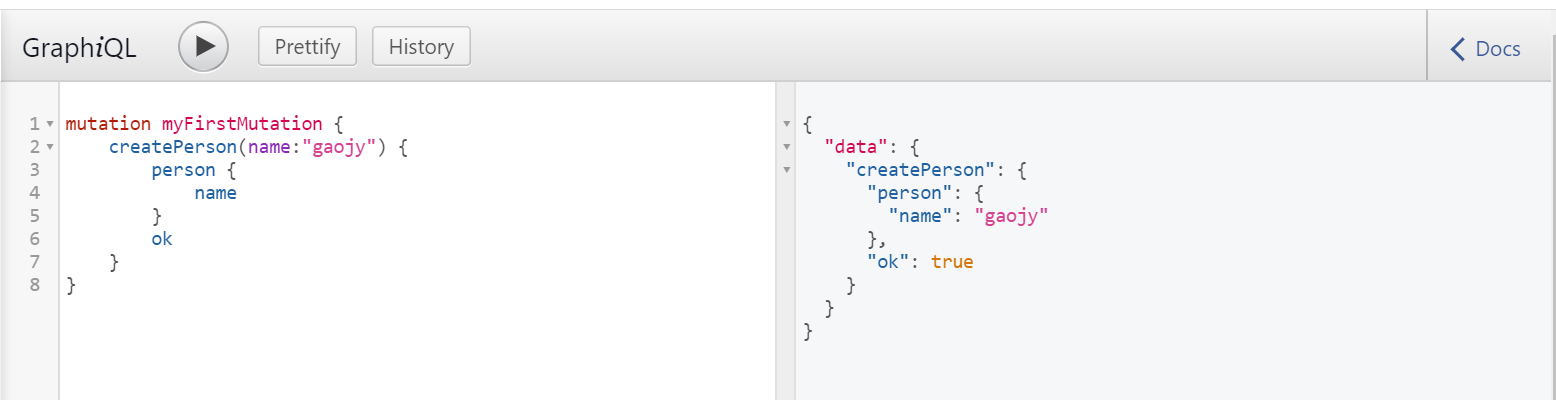
看下面一个操作示例
#具体的操作类
class CreatePerson(graphene.Mutation):
    # 请求提交的参数,同样需要传递到mutate中
    class Arguments:
        name = graphene.String()

    ok = graphene.Boolean()
    person = graphene.Field(Person)

    def mutate(root, info, name):
        person = Person(name=name)
        ok = True
        #可执行具体的业务逻辑 包括写表 发消息等等
        return CreatePerson(person=person, ok=ok)


# Mutation
class MyMutations(graphene.ObjectType):
    create_person = CreatePerson.Field()
#指定mutation  MyMutations
schema = Schema(query=Query,mutation=MyMutations)
执行结果如下:
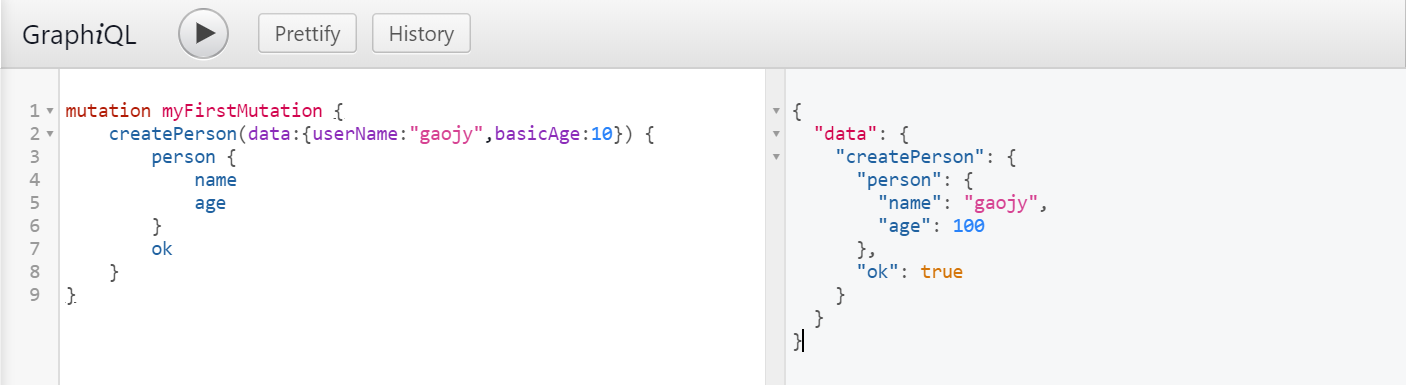
Mutation下可申明InputFields 和InputObjectTypes类型的出入参,其中InputFields可以定义复合型入参,Output可指定复合型出参。
例1:InputFields
class DataInput(graphene.InputObjectType):
    user_name = String()
    basic_age = Int()

class Person(graphene.ObjectType):
    name = graphene.String()
    age = graphene.Int()

# 具体的操作类
class CreatePerson(graphene.Mutation):
    # 请求提交的参数,同样需要传递到mutate中
    class Arguments:
        data = DataInput(required=True)

    ok = graphene.Boolean()
    person = graphene.Field(Person)

    def mutate(root, info, data):
        person = Person(name=data.user_name, age=data.basic_age * 10)
        ok = True
        return CreatePerson(person=person, ok=ok)
执行结果:
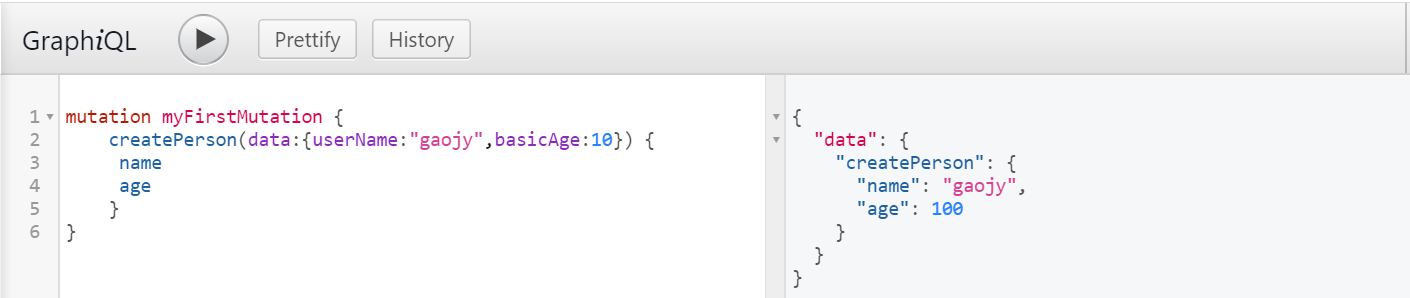
例2:InputObjectTypes
class DataInput(graphene.InputObjectType):
    user_name = String()
    basic_age = Int()


class Person(graphene.ObjectType):
    name = graphene.String()
    age = graphene.Int()

# 具体的操作类
class CreatePerson(graphene.Mutation):
    # 请求提交的参数,同样需要传递到mutate中
    class Arguments:
        data = DataInput(required=True)
    # 定义一个Output 且指定class ,在mutate方法中返回实例
    Output = Person
    def mutate(root, info, data):
        person = Person(name=data.user_name, age=data.basic_age * 10)
        return person
运行结果:
relay
relay类似于react js中的redux,VUE中的vuex,可以缓存server端数据,加快查询并提供更新机制。example可参考前言中的example。
小结
技术本身就是为业务服务,读者会问Graphql究竟可以使用在哪些业务场景呢?
官方有这么一句话ask exactly what you want.如果一个前端的接口只需要返回部分数据,而另一个前端接口也只需要返回部分数据,这两份数据有可能有交集,也可能没有。传统的做法可能需要开发两个接口或者一个接口内不断的if else来根据前端的具体场景去过滤某些数据。使用Graphql能够根据client指定需要哪些参数,后端scheme返回哪些参数,而后端只需要一个API可以查询到数据全集,Graphql可以自动完成数据解析,封装,过滤操作。
来源:https://www.cnblogs.com/gaojy/p/11678191.html |



 發表於 2019-10-16 12:14:00