CPU作为手机的中央处理器,可以说是手机最关键的组成部分,所有应用程序都需要它来调度运行,资源有限。所以当我们的APP因设计不当,使 CPU 持续以高负载运行,将会出现APP卡顿、手机发热发烫、电量消耗过快等等严重影响用户体验的现象。
因此我们对应用在CPU中占用率的监控,将变得尤为重要。那么我们应该如何来获取CPU的占有率呢?!
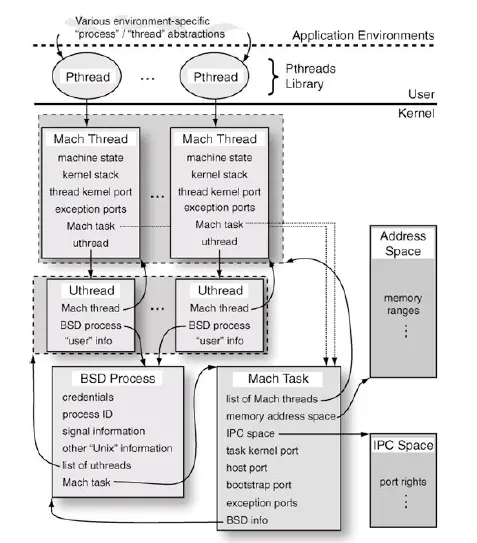
我们都知道,我们的APP在运行的时候,会对应一个Mach Task,而Task下可能有多条线程同时执行任务,每个线程都是作为利用CPU的基本单位。所以我们可以通过获取当前Mach Task下,所有线程占用 CPU 的情况,来计算APP的 CPU 占用率。
在《OS X and iOS Kernel Programming》是这样描述 Mach task 的:
任务(task)是一种容器(container)对象,虚拟内存空间和其他资源都是通过这个容器对象管理的,这些资源包括设备和其他句柄。严格地说,Mach 的任务并不是其他操作系统中所谓的进程,因为 Mach 作为一个微内核的操作系统,并没有提供“进程”的逻辑,而只是提供了最基本的实现。不过在 BSD 的模型中,这两个概念有1:1的简单映射,每一个 BSD 进程(也就是 OS X 进程)都在底层关联了一个 Mach 任务对象。
Mac OS X 中进程子系统组成的概念图
iOS 是基于 Apple Darwin 内核,由kernel、XNU和Runtime 组成,而XNU 是Darwin 的内核,它是“X is not UNIX”的缩写,是一个混合内核,由 Mach 微内核和 BSD 组成。Mach 内核是轻量级的平台,只能完成操作系统最基本的职责,比如:进程和线程、虚拟内存管理、任务调度、进程通信和消息传递机制等。其他的工作,例如文件操作和设备访问,都由 BSD 层实现。
iOS 的线程技术与Mac OS X类似,也是基于 Mach 线程技术实现的,在 Mach 层中thread_basic_info 结构体封装了单个线程的基本信息:
struct thread_basic_info {
    time_value_t  user_time;      /* user run time */
    time_value_t  system_time;    /* system run time */
    integer_t    cpu_usage;       /* scaled cpu usage percentage */
    policy_t     policy;          /* scheduling policy in effect */
    integer_t    run_state;       /* run state (see below) */
    integer_t    flags;           /* various flags (see below) */
    integer_t    suspend_count;   /* suspend count for thread */
    integer_t    sleep_time;      /* number of seconds that thread  has been sleeping */
}
一个Mach Task包含它的线程列表。内核提供了task_threads API 调用获取指定 task 的线程列表,然后可以通过thread_info API调用来查询指定线程的信息,在 thread_act.h 中有相关定义。
/*
 * phys_footprint
 *   Physical footprint: This is the sum of:
 *     + (internal - alternate_accounting)
 *     + (internal_compressed - alternate_accounting_compressed)
 *     + iokit_mapped
 *     + purgeable_nonvolatile
 *     + purgeable_nonvolatile_compressed
 *     + page_table
 *
 * internal
 *   The task's anonymous memory, which on iOS is always resident.
 *
 * internal_compressed
 *   Amount of this task's internal memory which is held by the compressor.
 *   Such memory is no longer actually resident for the task [i.e., resident in its pmap],
 *   and could be either decompressed back into memory, or paged out to storage, depending
 *   on our implementation.
 *
 * iokit_mapped
 *   IOKit mappings: The total size of all IOKit mappings in this task, regardless of
     clean/dirty or internal/external state].
 *
 * alternate_accounting
 *   The number of internal dirty pages which are part of IOKit mappings. By definition, these pages
 *   are counted in both internal *and* iokit_mapped, so we must subtract them from the total to avoid
 *   double counting.
 */
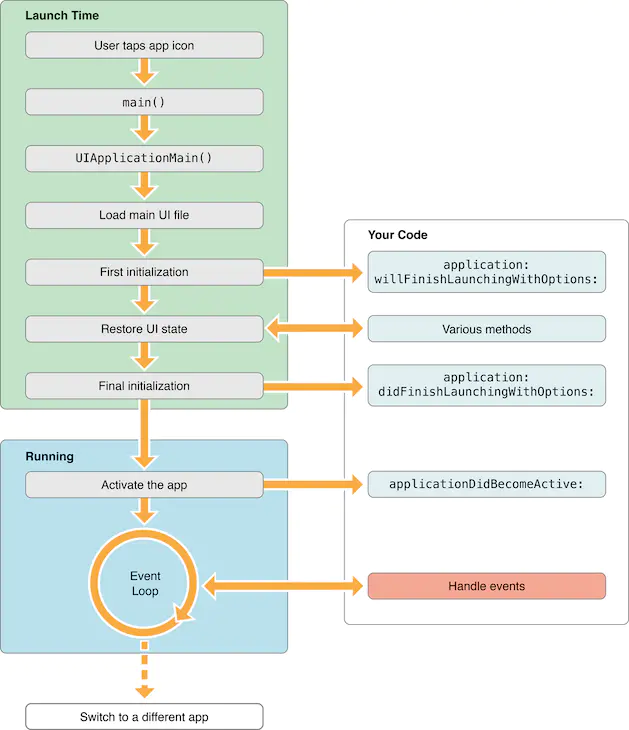
In Xcode, Mac templates default to including a “main.swift” file, but for iOS apps the default for new iOS project templates is to add @UIApplicationMain to a regular Swift file. This causes the compiler to synthesize a mainentry point for your iOS app, and eliminates the need for a “main.swift” file.



 發表於 2021-12-17 10:28:00